This is the plain-language summary of a much longer and more technical deep dive, Where Europe's electric trucks will stop: the truck charging market, mapped to 2035. The deep dive carries the supply count, the driver’s-clock arithmetic, the grant-by-grant review, 8 charts, the corridor model’s assumptions and 106 sources. Everything here is drawn from it; if a number needs its footnote, it is there.
Europe has about 60 electric truck models on sale, 730 public charging points reserved for trucks, and a rulebook that tells every driver exactly when to stop. Put those three facts on one map and the truck charging market stops being a lobbying number and becomes a list of roads.
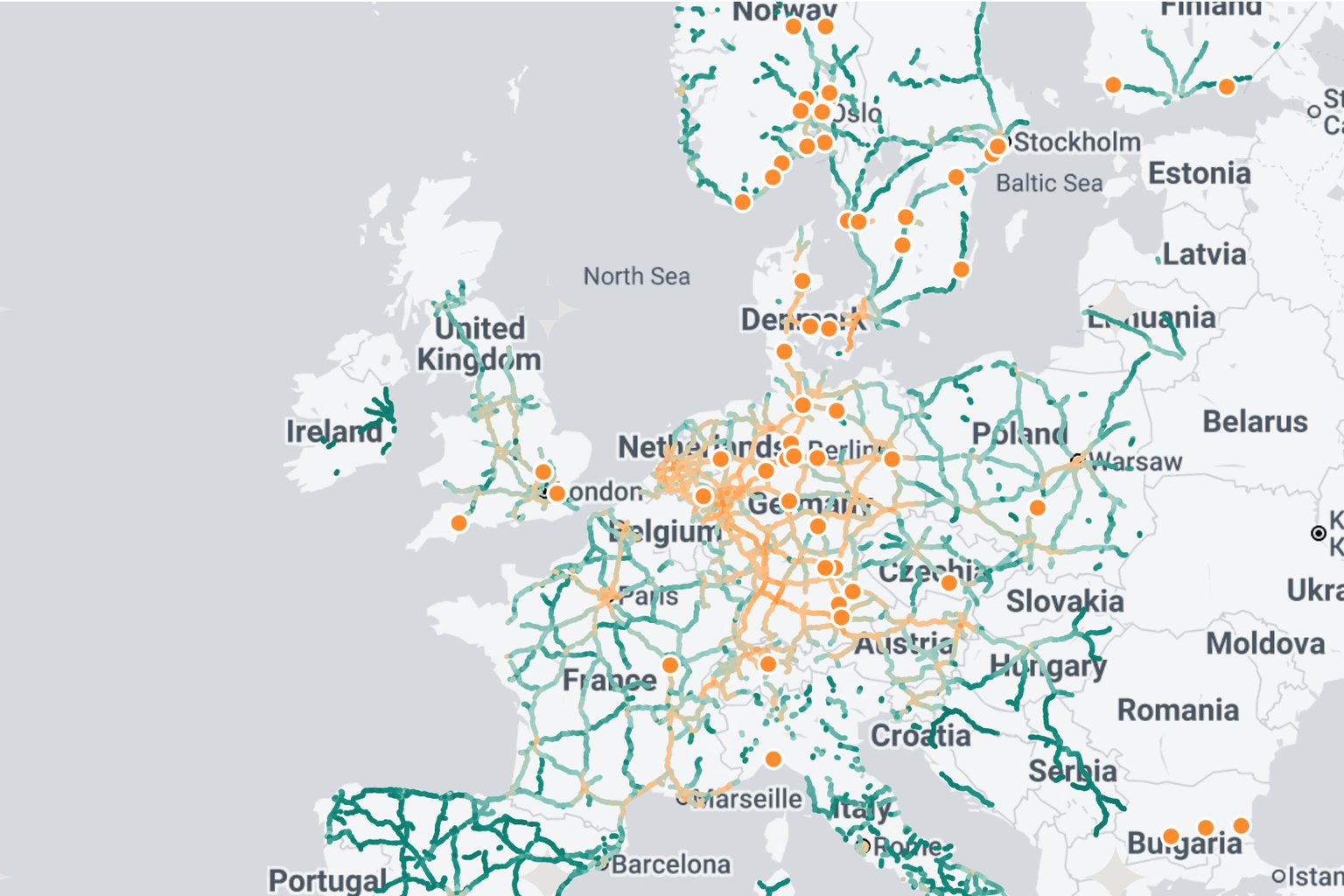
This is the short read of our deep dive on truck charging. The map below is the whole argument: where the break-charging demand lands on 80 000 km of European motorway, year by year to 2035, with the megawatt sites that exist today drawn on top. Step through the years, switch the metric to bays, hover a stretch. Then read on for why the shape looks like that.
Break-charging demand per stretch of motorway, central path, by year. Orange dots: truck charging sites we can place today, from Chargalytics data (a connector rated 700 kW or more) and openings reported since Nov 2025. Belgium excluded.
Chargalytics corridor model on national count-station AADT (see data notes). Dot size scales with total break energy on the stretch, colour with energy per kilometre or with the bays a 60 km AFIR pool on that stretch would need at a 5% chance of queueing. Belgium excluded (no road traffic data); Italy partial.
Supply is real, thin, and counted five different ways
Ask how many truck chargers Europe has and you get five answers. The EU observatory counts 730 public points reserved for trucks, or about 940 locations a truck can physically use once you include car hubs with a long enough bay. The ICCT counts roughly 2 450 truck-dedicated chargers. Germany's own register lists 88 sites designed for a 16.5 m truck. The definitions differ; the picture does not. Sweden, Germany and France hold two-thirds of the reserved points, seventeen EU member states have none, and the live megawatt list is short enough to print.
Our own filter is deliberately blunt. Nothing built for cars is rated above 500 kW per plug, so any site with a connector rated 700 kW or more is truck hardware by definition. That finds about 40 sites in ten countries, the ones you would expect: Milence at Landvetter, the Mercedes-Benz hub in Hamburg, ORLEN's motorway hubs in Poland, OK Truck at Korsør, Plugit's ports in Finland. Add the openings reported in the news since November and you have the orange dots on the map. It is not a long list for a continent.
The build-out is coming, though. Milence runs 38 hubs and wants 50 by Christmas. Germany has awarded 447 megawatt points across 124 unmanaged motorway rest areas, and its first seven megawatt plugs went live this summer. Every charger maker now ships a megawatt product. What nobody publishes is how busy any of it is, or what a site costs to build. In a market this young, the absence of a utilisation figure is itself a data point.
Demand is a timetable, not a guess
Car charging demand is a behavioural question: when people choose to plug in, for how long, and whether they could have charged at home instead. Truck charging demand is a regulation. Under EU driving-time rules a driver may run 4.5 hours, then must rest 45 minutes, and after nine to ten hours of driving must stop for eleven. Nobody chooses when to stop. The clock does.
Solve that for a 40-tonne truck at 80 km/h and the numbers fall out. A leg is 360 km and burns about 400 kWh. The second leg is the one that sizes the pack, because the 45-minute break can only refill the fast part of the battery: about 566 kWh installed, and roughly 743 kW of charging power to put a leg's worth of energy back inside the break. That is not a coincidence. It is what MAN, Scania and Mercedes-Benz shipped to Hannover: packs of 600 to 620 kWh and megawatt-ready inlets, built to the clock.
It also explains why a 400 kW plug is a depot plug, not a corridor plug. At 400 kW the break buys 194 km of a 360 km leg, and the driver is back on the road with a half-empty truck. The trucks themselves have turned up on time: electric share of new heavy trucks in the EU passed 2% in 2025 and is heading for 5% this year, with Germany already there and China at 29%. The fleet is not the constraint. Where it can stop is.
The corridor market is smaller than the lobby says
Our model is short enough to describe in a sentence. Take the measured heavy traffic on each stretch of motorway, keep the long-haul share, apply an electric share that rises from under 2% today to 25% in 2030 and 65% in 2035, multiply by 1.1 kWh per kilometre, and assume 30% of that energy is bought at compulsory breaks on the corridor. Everything else happens at depots and overnight. The result is break charging of about 17 GWh a day in 2030 and 40 GWh in 2035 on the roads we can measure.
Turn energy into hardware with the same queueing maths a telecom engineer uses for phone lines, sized so an arriving driver waits at most one time in twenty, and the corridor needs roughly 2 650 megawatt bays in 2030 and 6 300 in 2035. Not per country. In total.
Megawatt bays: what the corridor arithmetic needs against what has been promised and what is asked for
Teal: this model. Amber: published figures. The model covers 21 countries’ motorways at a 5% queueing target; a 1% target adds about 30% more bays.
The VDA asks for 35 000. The gap is not a rounding error; it is a different question. The lobby number covers every road, every depot and a fleet sized for compliance rather than for economics; ours covers the corridors, the break, and the trucks that will actually be there. Academic estimates that assume every truck charges at every break land much higher too, and that is the assumption to argue with. Uncomfortably for the industry, our 2030 figure is close to what has already been awarded: the German motorway tender, the E.ON consortium and Milence's plan add up to about a thousand bays between them. The industry is not short of ambition. It is short of the right addresses.
Two-thirds of 2030 demand sits on twenty roads
This is where the map earns its place. Truck traffic is not spread evenly across a continent; it runs down a few spines. The A2 near Hanover carries 23 000 heavy vehicles a day, the AP-7 outside Barcelona 30 000, the Brenner about 7 000. When the electric share is small, only the busiest stretches generate enough breaks to justify a megawatt site, so the early market is a short list of roads in a specific order.
Nine of the twenty are German Autobahnen. The A3, A7, A1, A2, A5, A8, A9 and A4 lead, with the Swiss A1, the Dutch A15 and A16 and the French A7 close behind. Germany alone accounts for 6.3 GWh a day of corridor demand in 2030, more than a third of the total: heavy traffic, an early fleet, and a toll exemption for electric trucks that runs to mid-2031.
Break-charging energy per day by country, 2030, central path (MWh)
Same model. Germany’s lead is heavy traffic plus the toll exemption plus early adoption; Poland and Spain have the traffic and not yet the trucks.
The Nordic corridors light up early on adoption rather than traffic, which is why Norway's E6 and Sweden's E4 sit alongside German roads carrying ten times their flow. Poland and Spain are the mirror image: they have the traffic and not yet the trucks, and their turn comes after 2030. That is the map's real message. The bays are not the shortage. Bays in the right order, on the right roads, are.
Grants place chargers by spacing. Trucks stop by traffic
A compulsory 45-minute stop at a fixed interval is the textbook queueing problem, which is why corridor rules work better for trucks than they ever did for cars. A car driver who finds a full site drives on; a truck driver who has run out of clock cannot. So spacing rules do real work here, and the EU's infrastructure regulation, AFIR, sets them: a charging pool of at least 3 600 kW every 60 km on the core network by 2030.
The catch is that AFIR sets kilowatts and spacing, never bays, and scales nothing with heavy flow. A pool on the A2 and a pool on a quiet Portuguese motorway carry the same obligation. We reviewed nine national and EU funding schemes, from Germany's €1bn programme to the Dutch toll recycling, Poland's PLN 2bn and Sweden's pilots. Only one, the German motorway tender, sizes sites on measured traffic. The rest place chargers where the map is empty rather than where the trucks are.
The money is oversubscribed and the grid is the queue
Capital is not the constraint. Germany's first three funding calls asked for €1.05bn against €300m available; one call was tripled on the day and still closed oversubscribed. The EU's AFIF fund spent its second billion by November 2025 and cancelled the next cut-off. Operators have raised the money too: Milence's €120m debt line and Voltix's €90m are the two largest of this year's rounds.
The economics are tight rather than broken. Megawatt hardware costs around €340 000 to €460 000 per megawatt, and the grid connection for a four-bay hub adds close to a million euros on its own. At today's utilisation the cost of a delivered kilowatt-hour on the corridor works out at 17 to 27 cents before margin, against Milence's list price of 40 cents and a diesel-equivalent of about 33. The sums close once the trucks arrive. They do not close while a site waits for its connection.
And it waits. Every operator, ministry and trade body we read agrees the bottleneck is the grid: two to three years for a connection in Germany, a waiting list of 15 000 in the Netherlands. A truck hub needs a connection the size of a small town, on a rest area that was never wired for one. The grant arrives in months; the transformer arrives in years.
Nobody is funding the eleven hours
The megawatt debate is about the 45-minute break. The overnight rest is a different product. A truck parked for eleven hours needs only 40 to 50 kW to leave full in the morning, hardware a supermarket car park already has. What it needs instead is a parking space, and Germany is short about 20 000 of those tonight.
In our model overnight charging is a third as much corridor energy again, none of it megawatt, and none of it in any grant scheme we could find. It is the cheapest energy a truck will ever buy and the least glamorous infrastructure anyone will ever build. That is usually a sign that nobody is building it.
What it adds up to
The truck charging market is a smaller problem than the lobby says and a harder one than the grants assume. Two to three thousand megawatt bays serve 2030 on the motorways we can measure. They have to sit on twenty roads, in the order the heavy traffic dictates, with grid connections that take longer than the trucks do to arrive. The chargers will be built. Whether they are built where the trucks stop is the open question.
Three things will tell us. Whether the 124 German rest areas awarded in June land on the A3, A7 and A1 first. Whether Milence reaches 50 hubs by year end with plugs above 400 kW. And whether anyone, anywhere, publishes a utilisation figure for a truck hub.
The full deep dive, with the supply count, the driver's-clock arithmetic, the grant-by-grant review and the model's assumptions, is here: Where Europe's electric trucks will stop: the truck charging market, mapped to 2035.