Norway doesn’t take its autumn break all at once. The school calendars split the country in two: some counties are off this week, the rest go next week, and the line between them is drawn by municipal councils rather than by anything as tidy as geography.
So we decided to use our dataset in a little blind test. Forget the calendars. Using only what we can see, 1 245 road counters from Statens vegvesen and the fast chargers in our Norwegian panel, can we work out who is on holiday this week, and where they've gone to? How correct will our guess be when we check against the official holiday calendars in the end? And what can you take away from this if you operate a charging network, or plan to use one?
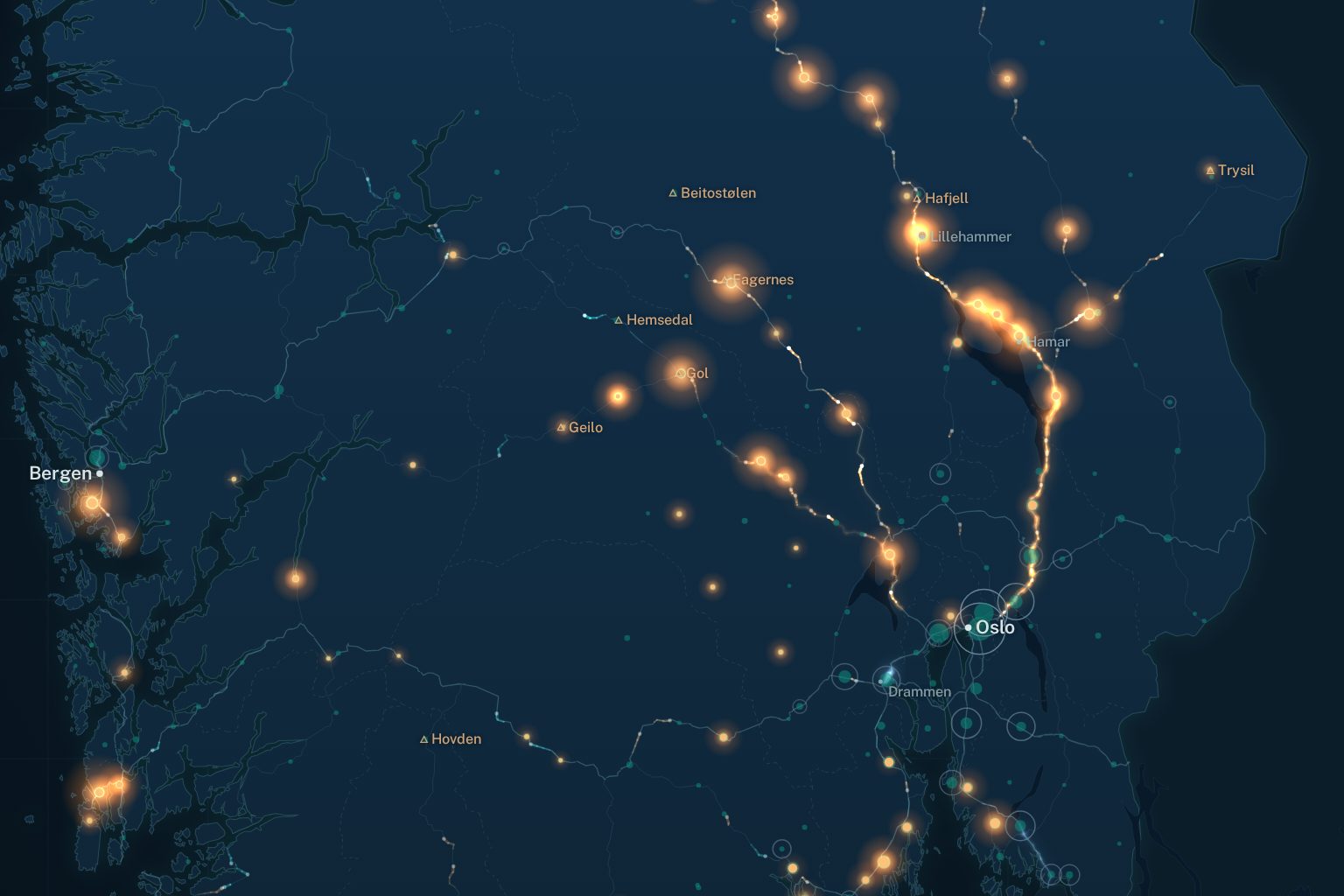
Extra traffic and fast-charging load against a normal September week, southern Norway, hour by hour from Thursday 24 to Monday 28 September 2026
Amber: more cars than on a normal September day, heading away from the cities. Teal: more cars than normal heading home. Glowing dots: fast chargers busier than their normal for that weekday and hour; grey rings: quieter. Baseline: the same weekday and hour in the three weeks from 31 August (traffic) and in weeks 37–38 (charging). Counters in Oslo, Bærum and Asker are left off the map because weekend roadworks diversions on the E18 and night tunnel closures dominated them. Sources: Statens vegvesen traffic counts, Chargalytics.
Clue one: Thursday was a red herring
Extra cars per hour on roads in 51 mountain and cabin municipalities, compared with a normal September week, by direction
Hourly vehicle counts at 91 continuous registration points in mountain and cabin municipalities, Thursday 24 to Monday 28 September 2026, minus the median of the same weekday and hour on 31 August–18 September. "Out" is the direction that normally carries Friday-afternoon cabin traffic. Source: Statens vegvesen trafikkdata.
The folk wisdom says families slip away on Thursday. Not this year. On the counters in Norway’s mountain and cabin municipalities, Thursday was if anything a touch quieter than normal. Nobody left early. They left after work.
The Friday wave builds from lunchtime and peaks at 21:00, when the mountain roads carried 58% more outbound traffic than a normal Friday at that hour. That’s the after-dinner departure: kids fed, car packed, headlights on. Saturday brings the bigger wave, a broad hump from 09:00 to 17:00 that tops out at 13:00 with 4 700 extra cars an hour. From Friday lunchtime to Saturday midnight, the extra traffic added up to about 54 000 passes of a counter, 18% more than normal for those hours. That counts cars at counters, not households, because one car can pass several.
Clue two: the Sunday that didn’t happen
A sunny September weekend also sends people to the cabin. The difference is that they come back. A normal Sunday on the mountain roads is the heaviest homeward day of the week, and it starts before lunch.
This Sunday it didn’t. Between 09:00 and midnight, 16 000 fewer cars than usual made the trip home, 6.8% below a normal Sunday, and at 13:00 the return flow ran 2 350 cars an hour light. That rules out a nice-weather weekend. The people who left on Friday and Saturday weren’t planning to be at their desks on Monday.
Clue three: the chargers in the hills
The fast chargers saw the same crowd arrive. Sites in 51 mountain and cabin municipalities, from Hallingdal and Valdres to Gudbrandsdalen, Setesdal and Trysil, ran 29% above their normal Saturday load. On Monday they ran 38% above a normal Monday, which in those valleys made it busier than an ordinary Saturday. A Monday in Hemsedal isn’t supposed to look like that.
But these clues say that someone left, not who. The traffic poured out of the Oslo region and up Setesdal from Kristiansand, but the Rv7 and E16 carry Bergen’s cabin traffic too. For a name, we need to look at who didn’t turn up.
Clue four: the empty Monday
Morning rush-hour traffic (06:00–09:00) on Monday 28 September, change against a normal Monday, by county (%)
Sum of vehicles at 1 245 continuous registration points on E and national roads, compared with the median of the same hours on the three preceding Mondays (31 August–14 September). Amber: a drop of more than 5%, which is where we drew the line. Source: Statens vegvesen trafikkdata.
A holiday is easiest to spot in the rush hour. Take away the school run and the parents who took the week off, and Monday morning goes soft. So we compared traffic between 06:00 and 09:00 on Monday 28 September with the three Mondays before it. Those are clean: the week before showed no dip anywhere, so nobody took their break in week 39.
The split isn’t subtle. Seven counties lost between 9% and 16% of their Monday-morning traffic. Seven more moved by less than 3%. Only Troms sits in between, at −3.9%, and we’ll come back to it.
Our verdict: Oslo, Akershus, Buskerud, Østfold, Agder, Nordland and Finnmark are on holiday this week. Everyone else is at school and goes next week.
The reveal
What the Monday rush hour said, against the official school calendars for autumn 2026
| County | Monday 06–09 vs normal | Our verdict | Official høstferie | Right? |
|---|---|---|---|---|
| Agder | −15.7% | Week 40 | Week 40 | Yes |
| Finnmark | −15.2% | Week 40 | Week 40 | Yes |
| Østfold | −12.4% | Week 40 | Week 40 | Yes |
| Nordland | −11.9% | Week 40 | Week 40 | Yes |
| Buskerud | −10.8% | Week 40 | Week 40 | Yes |
| Akershus | −8.9% | Week 40 | Week 40 | Yes |
| Oslo | −8.7% | Week 40 | Week 40 | Yes |
| Troms | −3.9% | Not this week | Week 40, Wed–Fri only | Yes, for Mon–Tue |
| Innlandet | −2.4% | Not this week | Week 41 | Yes |
| Trøndelag | −2.4% | Not this week | Week 41 | Yes |
| Vestfold | −1.3% | Not this week | Week 41 | Yes |
| Rogaland | −0.9% | Not this week | Week 41 | Yes |
| Møre og Romsdal | −0.7% | Not this week | Week 41 | Yes |
| Telemark | −0.2% | Not this week | Week 41 | Yes |
| Vestland | +0.2% | Not this week | Week 41 | Yes |
Official weeks from each county’s and the largest municipalities’ own 2026/27 school calendars (sources below). Week 40 = 28 September–2 October, week 41 = 5–9 October.
Traffic: hourly counts from 1 245 continuous Statens vegvesen registration points on E and national roads, against the median of the same weekday and hour on 31 August–18 September. Direction of travel is taken from each counter’s normal Friday-versus-Sunday pattern.
Charging: DC load (charging minutes ÷ bays × clock minutes) on a fixed panel of 1 370 Norwegian fast-charging sites with 11 203 bays, against weeks 37–38. AC is left out because its status feed was unstable in September.
Data runs to 08:00 on Tuesday 29 September.
Seven out of seven, and all seven of the counties we sent to school are indeed at school. The Monday rush hour turned out to be a better detective than we’d any right to expect.
Troms is the interesting one. Its schools are on holiday this week too, but only from Wednesday: Monday and Tuesday are ordinary school days in Tromsø and Harstad. Our −3.9% said ‘not yet’, which is right for the two days the data could see. Ask again on Thursday.
The data also found an exception hiding inside a county. Innlandet as a whole takes week 41 and its Monday barely moved (−2.4%). But Gran, down in Hadeland, shares its calendar with Oslo and Akershus, and its counters dropped 15%. A county map would have missed that.
Now the misses. At municipality level, Levanger in Trøndelag (−14%) and Storfjord in Troms (−17%) looked every bit as on holiday as Kristiansand (−16%), and neither is. A handful of counters on one road can be moved by a single roadworks diversion, so small places make unreliable witnesses. The Sunday clue fooled us too: Vestfold, Telemark and Innlandet all showed a light Sunday return, most likely because their roads carry the Oslo region’s cabin traffic home. Call it a borrowed absence.
What it means if you run chargers
Fast-charging load against a normal week, by day and type of place (%)
DC percent load (charging minutes ÷ bays × clock minutes) on a fixed panel of Norwegian fast-charging sites, each day against the mean of the same weekday in weeks 37–38. Mountain: 51 cabin and mountain municipalities. Week-40 cities: Oslo, Bærum, Asker, Lillestrøm, Drammen, Kristiansand, Fredrikstad, Bodø and 14 more. Week-41 cities: Bergen, Trondheim, Stavanger, Sandnes, Ålesund, Tønsberg and 14 more. Source: NOBIL real-time status via Chargalytics.
For a charge point operator the autumn break isn’t a boom. It’s a relocation. On Friday and Saturday, fast chargers in the week-40 cities ran about 4% below normal while Bergen, Stavanger and Trondheim ran 1–3% above. The mountains gained 29% on Saturday and 38% on Monday. Add it all up and the national panel never moved by much more than 5% on any day.
City fast chargers also flinched far less than city traffic did. Our reading: a big share of an urban DC site’s day is taxis, ride-hail and drivers without a home charger, and none of them go to the cabin because the school closed. The load that leaves is the family car, and it leaves for places where a normal Monday is a quiet day and the site was sized for one.
Next week it’s the other half’s turn. Vestland, Rogaland, Trøndelag, Møre og Romsdal, Vestfold, Telemark and most of Innlandet break up after school on Friday 2 October. If they follow this week’s script, expect a Friday-evening peak around 21:00, the bigger wave before lunch on Saturday, a second wave on Monday afternoon, and a Sunday that doesn’t happen. The west-side valleys get their turn this time: Voss, the Hardangervidda end of the Rv7, Sirdal and Hovden. We’ll be watching.
Sources
- Statens vegvesen, trafikkdata API (hourly volumes by direction)
- Oslo kommune, skolerute 2026/27 (Lovdata)
- Akershus fylkeskommune, skoledager og ferier
- Buskerud fylkeskommune, skoledager og ferier
- Østfold fylkeskommune, skoledager og ferier
- Agder fylkeskommune, skoledager og ferier
- Kristiansand kommune, skoleruta
- Nordland fylkeskommune, skolerute 2026–2027
- Bodø kommune, skolerute (Lovdata)
- Finnmark fylkeskommune, skolerute (Lovdata)
- Troms fylkeskommune, skolerute
- Tromsø kommune, ferie og fridager
- Vestfold, felles skolerute 2026/27 (KS)
- Telemark, felles skolerute 2026/27 (KS)
- Rogaland fylkeskommune, skoledager og ferier
- Bergen kommune, skolerute (Lovdata)
- Vestland fylkeskommune, skolerute (Lovdata)
- Møre og Romsdal fylkeskommune, skolerute (Lovdata)
- Trondheim kommune, ferie og fridager
- Trøndelag fylkeskommune, skolerute
- Innlandet fylkeskommune, skolerute 2026–2027
- Gran kommune, skolerute (Lovdata)
- Kartverket via robhop/fylker-og-kommuner (map outlines, CC BY 4.0)